



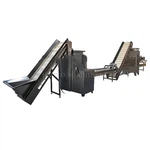


Feeder Belt Conveyor
Zhengzhou Hento Machinery Co., Ltd. is one of the most reliable manufacturers and suppliers of feeder belt conveyor in China. With abundant experience, we warmly welcome you to buy customized feeder belt conveyor from our factory. For more cheap products, contact us now.
Product Introduction

why choose our products
Feeder Belt Conveyor uses a high -quality bearing base and a high -intensity gear to allow the machine to run safely, stable, reliable, and not shake during the operation. The speed regulator can adjust the running speed of the conveyor belt. Different speeds are required to be equipped with motors of different power.
Advantages of Feeder Belt Conveyor
Feeder Belt Conveyors offer several advantages over other material handling equipment.
Efficient
Feeder Belt Conveyors are designed to move materials efficiently. They can transport materials at a high rate, which saves time and increases productivity.
Cost-effective
Feeder Belt Conveyors are cost-effective compared to other material handling equipment. They require less manual labor, which reduces labor costs.
Safe
Feeder Belt Conveyors are safer than other material handling equipment. They are designed to prevent material spillage, which reduces the risk of accidents.
Easy to operate
It can be automated to run continuously or can be operated manually.Versatile:It can be used to transport different types of materials such as coal, grain, and minerals.
Working Principle of Feeder Belt Conveyor
Feeder Belt Conveyors work on the principle of bulk material handling. They move materials in bulk from one process to another.Feeder Belt Conveyors consist of a series of components that work together to effectively transport materials. The components of a Feeder Belt Conveyor include:
Belt
The belt is the main component of the Feeder Belt Conveyor. It is made of durable material.
Motor
The motor powers the belt and provides the necessary torque to move materials.
Rollers
The rollers support the belt and help it move smoothly.
Hopper
The hopper is the container that holds the material to be transported.
Chutes
The chutes direct the material from the hopper onto the conveyor belt.
Sensors
The sensors provide precise control over the material flow.
When the Feeder Belt Conveyor is switched on, the motor powers the belt, which moves the rollers. The chutes direct the material from the hopper onto the conveyor belt, which transports the material to the next process. The sensors provide precise control over the material flow, ensuring that the materials are transported accurately and efficiently.
After-Sales Service of Feeder Belt Conveyor
We offer a comprehensive service
After-sales service is an essential part of owning a Feeder Belt Conveyor. It includes maintenance, repair, and replacement of worn-out parts. A good after-sales service ensures that the Feeder Belt Conveyor operates efficiently and effectively, minimizing downtime and maximizing productivity. Some of the after-sales services offered include:
Maintenance
Regular maintenance ensures that the Feeder Belt Conveyor operates efficiently and effectively. Maintenance includes cleaning, lubrication, and inspection of components.
Repair
If the Feeder Belt Conveyor breaks down, it needs to be repaired immediately to minimize downtime. A good after-sales service provider will offer repair services.
Replacement of worn-out parts
Replacement of worn-out parts: Worn-out parts need to be replaced to ensure that the Feeder Belt Conveyor runs smoothly.
Technical Parameter
|
Model |
HT-SS100 |
HT-SS500 |
|
Power |
200W |
700W |
|
Voltage |
220V |
220V |
|
Dimension |
2200*400*400-1250mm |
5000*300*180mm |
Hot Tags: feeder belt conveyor, China feeder belt conveyor manufacturers, suppliers, factory, Coffee Powder Grinder Machine, Electric Oil Filter Machine, Automatic Coffee Making Machine, Other Food Machinery, Robotic Delivery Food, Electric Jacketed Kettle
Previous
Feeder ConveyorYou Might Also Like


Send Inquiry