


Application of Milk Cooling Tank
A Milk Cooling Tank is used for cooling raw milk from the cow or buffalo to a temperature of 4°C immediately after milking.
Cooling raw milk is essential to preserve its quality and prevent the growth of bacteria that can lead to spoilage and reduce shelf life. Milk Cooling Tanks are also used to cool pasteurized and homogenized milk, cream, and other dairy products.

Advantages of Milk Cooling Tank
Improved Milk Quality
Milk Cooling Tanks help preserve milk quality by preventing the growth of bacteria, limiting the enzymatic activity, and reducing the risk of microbial contamination.
Extended Shelf Life
By keeping milk at a low temperature, Milk Cooling Tanks help extend the shelf life of milk and milk products by preserving their nutritional value and flavor.
Increased Efficiency
The use of Milk Cooling Tanks helps increase the production efficiency of dairy farms by reducing the time required to cool raw milk, which helps dairy farmers maximize their milk production.
Cost-Effective
Milk Cooling Tanks are cost-effective and can provide a quick return on investment by reducing spoilage, improving milk quality, and extending the shelf life of milk and milk products.
Working Principle of Milk Cooling Tank
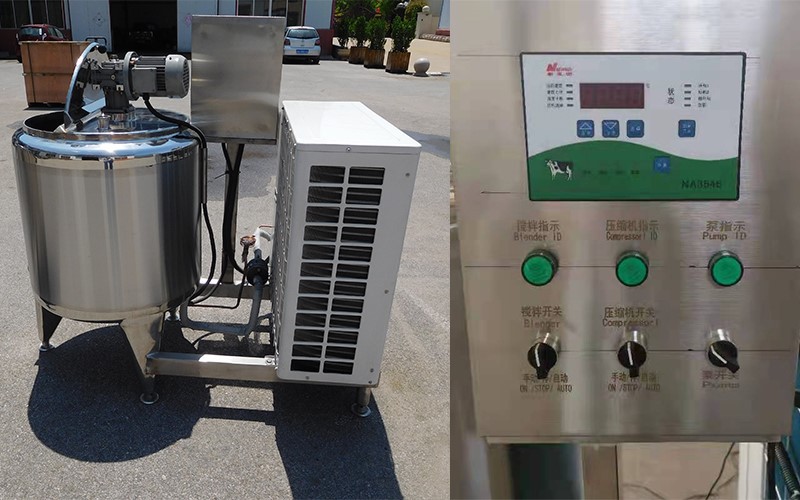
Milk Cooling Tanks are designed to cool milk quickly and efficiently to a temperature of 4°C or below. The tanks are made of high-quality stainless steel and are equipped with a refrigeration system that circulates chilled water around the tank to cool the milk.
The refrigeration system comprises a compressor, condenser, expansion valve, and evaporator. A compressor is used to compress the refrigerant gas, which then moves to the condenser, where the heat is dissipated.
The refrigerant gas then passes through the expansion valve, which reduces the pressure and temperature, and then moves to the evaporator. The evaporator is where the refrigerant gas absorbs heat and cools the water.
The milk is then cooled by the milk-cooling plates that are immersed in the tank. The cooled water circulates around the milk cooling plates and cools the milk quickly and efficiently.
The operation of Milk Cooling Tank is simple and straightforward. However, it is essential to follow certain guidelines to ensure efficient operation and prolonged service life. Here are the steps to follow when operating a Milk Cooling Tank.

01
Pre-Cooling
Before adding milk to the tank, ensure that the cooling system is operating correctly and that the tank is pre-cooled to the required temperature.
02
Filling the Tank
The milk should be added to the tank immediately after milking, ensuring that the temperature of the milk is not more than 30°C. The milk should be agitated while filling the tank to ensure proper mixing and even cooling
03
Cooling
Once the tank is filled, the cooling system should be turned on to cool the milk to the required temperature of 4°C or below. The ideal temperature for storing milk in the tank is 2-3°C.
04
Cleaning
Regular cleaning of the Milk Cooling Tank is essential to prevent the growth of bacteria, prolong the life of the tank. The tank cleaned daily after use, and the cooling system should be drained periodically.
Conclusion
Milk Cooling Tanks are an essential piece of equipment in the dairy industry, offering numerous advantages such as preserving the quality and nutritional value of milk, extending the shelf life of milk and milk products, and increasing production efficiency.
The working principle of Milk Cooling Tanks is based on chilling water that circulates around the tank to cool the milk. Operating the Milk Cooling Tank is simple and straightforward, as it requires pre-cooling, filling the tank, cooling, and cleaning. Dairy farmers must adhere to the guidelines when operating a Milk Cooling Tank to ensure efficient operation and prolonged service life.
FAQ
Q: What's the MOQ?
Q: Can the machine be customized?
Q: What's the payment term?
Q: How to ship?
Q: Which port do you send the goods from?
Q: How long is the warranty of the machine?
Q: How to buy this machine?
Q: What about the package?
Q: Do you need a supplier to provide transportation?
Q: Are there any requirements for power supply?
Q: What about Pre-sale service?
Q: What about After-sales service?


