


Equipment structure and working principle
Core structure
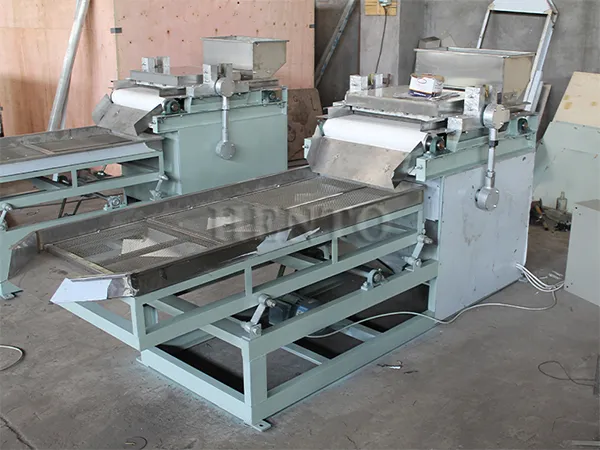
The Peanut Cutter Machine is mainly composed of four modules: feeding and conveying system, straight knife shredding system, vibrating grading screen, and discharge port
01
Feeding and conveying system
Using food grade conveyor belts, peanuts are evenly and smoothly fed into the cutting area to avoid particle size differences caused by uneven feeding.
02
Straight knife shredding system
The high-speed rotating stainless steel straight knife group is the core component, with adjustable blade clearance, cutting peanuts through shearing rather than squeezing to avoid oil and paste.
03
Vibration grading screen
The equipment comes with multiple layers of stainless steel screens with different aperture sizes, which automatically grade the chopped peanuts according to their particle size. Unqualified particles can be recycled for secondary cutting.
04
Multi channel discharge outlet
Peanut chips of different specifications (such as coarse, medium, and fine) are discharged from the corresponding outlet, achieving one-time processing and multiple finished products.
05
Workflow
This design achieves continuous and automated production without the need for manual secondary screening, greatly improving efficiency.
Peanuts (after peeling) → uniform feeding and conveying → precise cutting with a straight knife → vibrating screen grading and screening → different specifications of finished products are discharged separately → processing is completed.
Contact now
Core advantages
The chopping effect is uniform, and the finished product has high quality
The Peanut Cutter Machine adopts a shearing cutting method instead of traditional extrusion crushing. The peanut particles have a smooth surface, no powder, and no oil or paste phenomenon, which maximizes the preservation of the aroma and oil stability of peanuts.
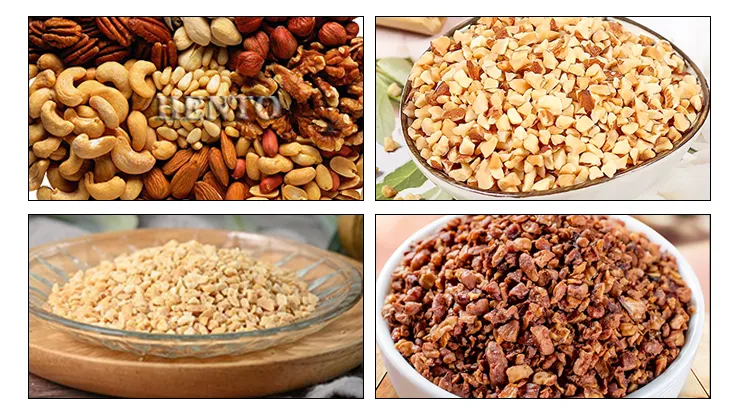
The blade gap can be adjusted and the particle size range covers a wide range (from 3-5mm coarse particles to 0.5mm fine particles), meeting the needs of different products, such as peanut crumbs for baking, candy fillings, etc.
Efficient and low consumption, suitable for industrial production
Stable production capacity, with mainstream models capable of producing 300-800kg/h, can be directly connected to production lines without the need for manual intervention.
The motor power adaptation is reasonable, the unit energy consumption is low, and the grading screen can automatically screen qualified particles, reducing rework rate and improving raw material utilization.
Food grade material, safe and easy to clean.The components that come into contact with the material (knife group, screen mesh, material trough) are all made of 304 stainless steel, which meets food hygiene standards, is corrosion-resistant, not easy to rust, and has no hygiene dead corners.
The sieve and knife set can be quickly disassembled for daily cleaning and maintenance, avoiding the growth of bacteria in residual materials and adapting to the compliance requirements of food factories.
One machine is versatile and suitable for multiple raw materials
In addition to peanuts, nuts such as almonds, walnuts, cashews, and chestnuts can also be processed. By adjusting the knife gap and sieve aperture, multiple raw materials and specifications can be processed, reducing equipment procurement costs.
Convenient operation and low maintenance cost,The operation process is simple, the parameter adjustment is intuitive, and even beginners can quickly get started.
The core components have strong durability, the blade assembly is replaceable, the screen mesh is not easily clogged, and the maintenance cost for long-term use is relatively low.
Applicable scenarios
Baking industry
Peanut flakes and fillings are used for surface decoration of bread, cakes, and cookies.
Food fillings
moon cake fillings, soup dumpling fillings, nuts in pastry fillings.
Casual snacks
Peanut candy, nougat, nut crisps, wrapped peanuts, etc.
Food ingredients
peanut chips used for chafing dish dip, Spicy Hot Pot, salad, etc.


